basics
Module pages (M1–M4)
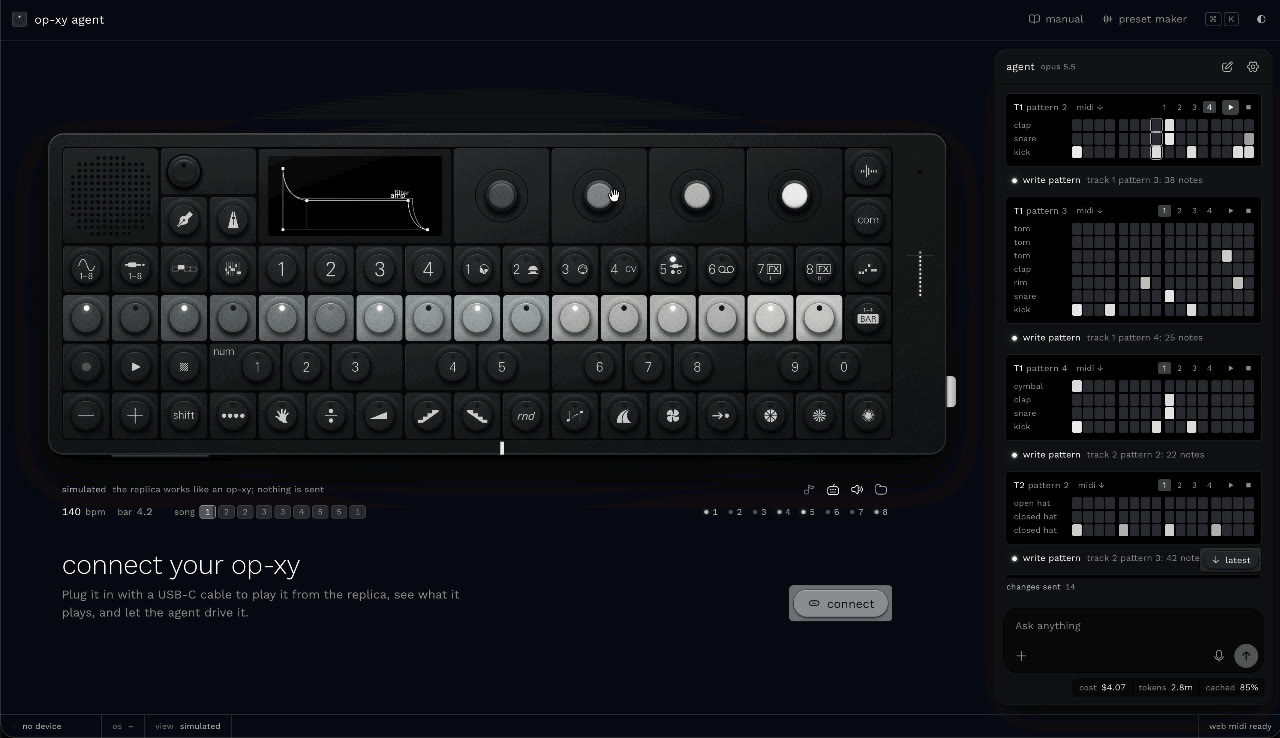
In instrument, auxiliary and mix mode the keys under the screen open four pages (modules), and the encoders edit what the open page shows. Arrange has no modules.
The mode decides what the pages are about and the track keys which track they edit. Any module-page parameter of an instrument or auxiliary track can be parameter-locked per step.
How to
Edit a page's shift-layer parameters
- 1
Details
- TE’s guide
Every main mode except arrange splits its controls into four modules, opened with the keys printed 1 to 4 under the screen (…).
- TE’s guide
On a module page, … edit the parameters shown for the selected track.
- TE’s guide
Pages with more than four parameters show the rest while is held.
- TE’s guide
On instrument tracks the pages are engine (), envelopes (), filter () and LFO (); and choose the filter type and LFO type, and brings up the preset browser, where OS 1.1.33 changes the engine.
- TE’s guide
Auxiliary tracks use the pages their own way; on the brain track, sets key and scale and routes tracks into it.
- TE’s guide
In mix mode, holds levels, pans and sends per track, the master EQ, the master saturator and the master section.
- checked on a unit · 1.1.33
On screen, each parameter carries a small dot or cap in its encoder's shade — dark for , mid grey for , light grey for , white for — so a glance tells which knob moves what.
- checked on a unit · 1.1.33
Brief popups, such as the octave card or the mixer's send display, sit over the page and go away on their own after about a second.
- community
Page changes are cuts, with no sideways slide, the brain's routing page included; when a page with soft-key labels appears, the labels stay hidden for about 70 ms, then rise from the lower edge over about 70 ms (tutorial videos, OS 1.0.x to 1.1.25).