the keys
Which key is which
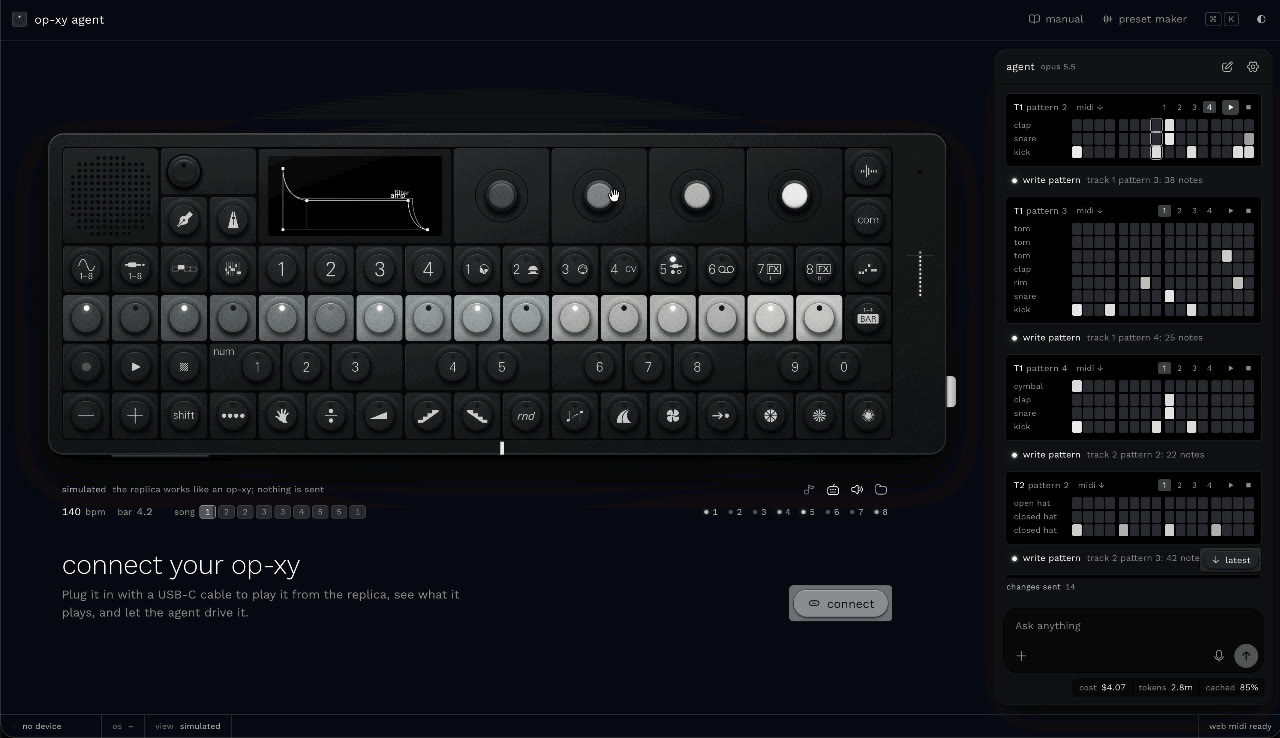
The manual and the agent call the keys by name — M3, T5, accidental 1 — but the OP-XY prints only digits and pictures. Here every key is drawn as it looks on the device, with the name we use. Point at one to find it on the replica; press it to watch it there.
Under the screen
open the four pages of the selected track: on an instrument track its engine, envelopes, filter and LFO. With they open the page’s second layer.
Tracks
select a track. After they select the eight auxiliary tracks instead, the brain to FX II.
Modes and functions
The keys round the screen: the four modes, then the pages and tools you open from anywhere.
Transport and shift
Recording, playing and stopping, the octave keys and , which every combo holds.
Steps
The sixteen step keys carry no print: the manual counts them from the left, , dark to white.
Keyboard
The lower row are the naturals, counted from the left: is F3, is E5. The num row above holds the accidentals, named by the digit printed on them, to and . The manual also names a key by its note: .
Encoders
, left to right: their caps are the colours the screen marks their values with. Turn one, or click it.
Knob, pad and switch
The volume knob, the pitch-bend pad on the front edge and the power switch.
How combos are written
Everywhere in the manual and the chat, keys pressed together are joined by a plus and keys pressed one after the other by an arrow. Press a combo to watch it on the replica.
-
shift + M1hold shift and press M1: every key but the last is held -
record + play → playpress the two together, let go, then press play -
shift + player → + turn E1→ +keeps the keys before it held -
hold coma long press -
turn E2turn an encoder ( pushes it) -
step n + turn E1…E4any step, any encoder: a letter or a range stands for a group -
[-]/[+]either key -
key F#3a keyboard key by its note
The rules in full: how key presses are written.