instrument
Drumline engine
OS 1.2 adds drumline, an engine that turns the 24 keys F3–E5 into synthesised drums. Each key holds one of ten drum models with four values of its own, and the shift layer adds random, pan, volume and a play mode.
Only TE’s changelog describes this; the guide does not.
Drumline is the OP-XY's synthesised alternative to the drum sampler. Instead of a sample on each key, every key runs a small drum synth, one of ten models, with four values to shape it. That makes a kit editable in a way samples are not: a kick can get shorter, a hat looser or a clap wider with a turn of an encoder, and per-hit random keeps repeated hits from sounding identical.
Select a key by playing it, then use the four encoders for the model's values and for the key's model, random, pan and volume. The whole kit is shaped on (see the kit unit).
How to
Change which drum a key plays
before you start instrument mode · a drumline track is selected
- 1 play the key whose sound you want to change; it becomes the selected key
- 2 steps through the ten models; the four values keep their numbers under the new names
The key plays the new model.
Change a key's play mode
before you start instrument mode · a drumline track is selected · the key is selected
- 1 each click steps to the next play mode
The key plays as key, oneshot, loop or in a mute group.
Details
- TE’s changelog
Drumline is a synth engine that plays a drum kit made by synthesis instead of samples; it arrived with OS 1.2.0 and is loaded from the preset browser, where its presets sit in a drumline category.
- community
The 24 keys F3–E5 (MIDI notes 53–76) are the drums, as on the drum sampler. Each key keeps its own model and its own four values, so a kit can hold any mix of drums.
- community
The keys play different drums, not different pitches; to play a pitch you change the key's pitch value.
- community
There are ten models, in the order that turning with held steps through them: kick, snare, hi-hat, shaker, clap, congas, fm, tom, tambourine and resonator.
- community
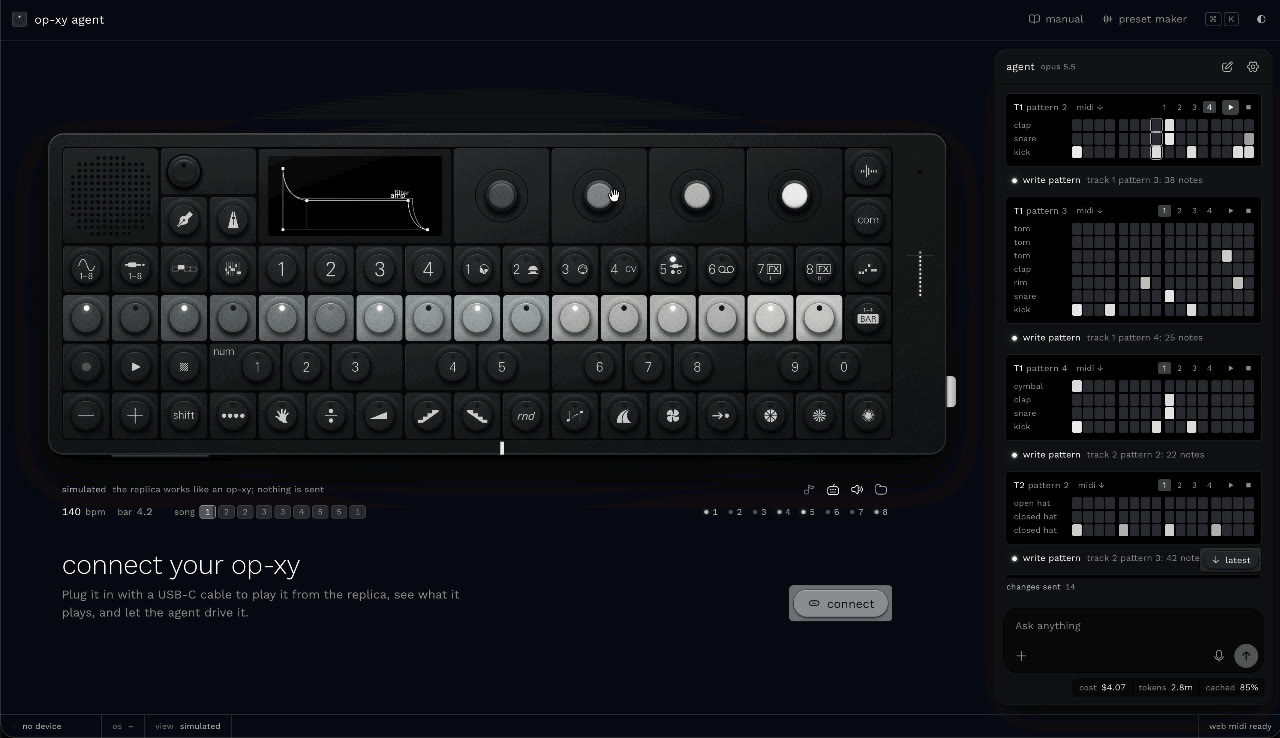
The M1 page shows a picture of the key's model with four boxes, E1 to E4, each a two-digit value 00–99. Their names depend on the model: kick pitch, length, punch, tone; snare pitch, length, snare, punch; hi-hat pitch, length, era, tone; shaker color, length, attack, onset; clap tone, length, spread, contour.
- community
The other models: congas pitch, length, slap, mush; fm pitch, length, mod, feedback; tom pitch, length, sweep, rate; tambourine tone, length, shake, ring; resonator pitch, length, tone, strike. Snare's punch and fm's feedback have not been seen on a real screen.
- community
E2 is always the length, the decay time of that key's hit, whatever the model; it is how one hi-hat model makes both closed and open hats.
- community
On a kick, punch adds drive to the start of the hit and tone shapes the balance of lows and highs. On a snare, the value named snare is the amount of noise (0 leaves the pitched tone alone) and punch is distortion.
- community
A clap is several quick claps, with spread setting the gap between them. A tom's sweep is centred, so 50 is no pitch movement, lower values glide down and higher values glide up, and rate is how fast.
- unconfirmed
What resonator strike does is not settled (listeners disagree), and hi-hat era, shaker onset, congas slap and mush and tambourine ring have no measured effect yet; treat their descriptions as guesses.
- community
With held, M1 shows the key's second layer: steps the model, is the key's random, its pan and its volume.
- community
Pan and volume are shown as 0–99. A centred pan reads 49, and a volume of 59 is the unchanged level, with about two numbers to the decibel above and below it.
- community
Random makes every hit of that key a little different by moving all four of its values each time it plays. Up to about 30 it is hard to hear; higher it is a new tone on every hit.
- community
A click of on M1 steps the key's play mode: key (sounds while held), oneshot, loop (the hit repeats, and length sets the repeat), and mute groups 1, 2 and 3. Keys in one group cut each other off, which is how a closed hat chokes an open one; the drum sampler has one group, drumline three.
- community
The clicks go note modes, then loop, then group 1, 2, 3 and back; whether both key and oneshot come before loop has not been settled on a unit.
- community
Holding a keyboard key shows a row under M1–M4 on the drumline page; its labels are scramble, copy, paste and reset. Scramble draws new values for the key and keeps its model; copy and paste work as on the drum sampler.
- community
The M3 filter (including the dynamic one), the arpeggiator and the punch-in effects all work on a drumline track; the filter and effects act on the whole kit.
- unconfirmed
Whether a parameter lock, automation or LFO on an M1 value moves one key or every key is not settled; one video suggests it offsets that value on all keys.
Parameters
| parameter | gesture | range | cc |
|---|---|---|---|
| first value (pitch, or tone or color) M1 | 00–99 | – | |
| length M1 | 00–99 | – | |
| third value M1 | 00–99 | – | |
| fourth value M1 | 00–99 | – | |
| model M1 | – | – | |
| random M1 | 00–99 | – | |
| pan M1 | 0–99 | – | |
| volume M1 | 0–99 | – | |
| play mode M1 | – | – |